Key Features

  • 2/3 Days of intense classroom training
  • 3 full-length simulated tests
  • Get 16 Contact Hours PDU certificate
  • Answers and explanations for practice questions
  • TUV-SUD approved course content material
  • Expert trainer with industry wide experience

Six Sigma Yellow Belt Certification in Hisar

  • City: Hisar
  • Country: India
  • Workshop Date:
  • Price (INR): -
  • Six Sigma Yellow Belt Certification Training in Hisar, India

Enhance Your Process Improvement Skills with Six Sigma Yellow Belt Certification Training in Hisar
Embark on your journey toward process excellence with our Six Sigma Yellow Belt certification training in Hisar. This foundational course introduces you to the core principles of Six Sigma, focusing on the DMAIC (Define, Measure, Analyze, Improve, Control) methodology. By enrolling in our Six Sigma Yellow Belt certification in Hisar you'll gain the tools and techniques necessary to identify inefficiencies and contribute to continuous improvement initiatives within your organization. Our Six Sigma Yellow Belt certification training in Hisar is designed for professionals across various industries, providing practical knowledge that can be applied immediately to enhance operational efficiency and quality standards. Whether you're new to process improvement or looking to formalize your skills, this training offers a solid foundation to support your career growth and organizational success.

Quick Enquiry
Loading...

SIX SIGMA YELLOW BELT CERTIFICATION TRAINING PROGRAM IN HISAR

E-LEARNING

INR : 9999.00 6999.00

  • Six Sigma Yellow Belt 180 days e-Learning
  • Self paced online e-learning
  • Interactive audio-video lessons
  • Online Exam Simulator
  • ebook and study materials
  • 24x7 Online access

ENROLL

Instructor-Led Live Online Class

  • Six Sigma Yellow Belt 35 Hours Instructor-Led Online Class Training
  • Live interactive sessions with experts
  • Real-time Q&A with instructors
  • Hands-on exercises and activities
  • Course materials and resources

Classroom Training

  • 4 Days Six Sigma Yellow Belt Boot Camp
  • Hands-on in-person training
  • Network with peers
  • Lunch & refreshments included
  • Dedicated training facility

SIX SIGMA YELLOW BELT TRAINING COURSE DESCRIPTION IN HISAR

Course Overview

The Six Sigma Yellow Belt Certification provides delegates with the fundamental understanding of Six Sigma presenting the basic concepts of Define, Measure and Control phase. Yellow belt is usually preferred by entry-level professionals in Quality Management and after successful completion of certification counsel on certain aspects of Six Sigma Implementation. The course will also assist in contributing to Green Belt projects within the organization. The course also provides an elementary understanding about other Six Sigma Belts like Green Belt, Black belt, Master Black Belt. Yellow Belt certification enables professionals to undertake smaller projects emphasizing on the PDCA ( Plan, Do, Check, Act) methodology.

Panelcs Courses is conducting Six Sigma Yellow Belt certification training course. Our Six Sigma Yellow belt certification training course includes three full-length simulation tests with answers and explanation provided by our trainer to ensure your success in the Six Sigma Yellow belt examination. We will also provide 35 contact hours certificate on completion of the course.

A Six Sigma certification showcases your commitment towards improving the business of your employer and makes you stand out from the crowd as a certified professional. Improve your career growth prospects with a Six Sigma certification. Please fill-in the enquiry form or e-mail info@panelcscourses.com to know more about our Six Sigma Yellow Belt certification training course.

SIX SIGMA YELLOW BELT TRAINING COURSE AGENDA IN HISAR

On completion of the Six Sigma Yellow Belt training program, participants will be:

1.         Define Phase          
1.1.      Overview of Six Sigma       
1.1.1.  What is Six Sigma  
1.1.2.  Six Sigma History   
1.1.3.  Six Sigma Approach          
1.1.4.  Six Sigma Methodology     
1.1.5.  Roles and Responsibilities           
1.2.      Six Sigma Fundamentals  
1.2.1.  Defining a Process 
1.2.2.  VOC and CTQs       
1.2.3.  Quality Function Deployment      
1.2.4.  Cost of Poor Quality           
1.2.5.  Pareto Charts and Analysis          
1.3.      Six Sigma Projects  
1.3.1.  Six Sigma Metrics   
1.3.2.  Business Case and Charter         
1.3.3.  Project Team Selection      
1.3.4.  Project Risk Management 
1.3.5.  Project Planning     
1.3.6.  What is Project Plan?         
1.4.      Lean Fundamentals           
1.4.1.  Lean and Six Sigma           
1.4.2.  History of Lean        
1.4.3.  Seven Deadly Muda          
1.4.4.  1.4.4 Five-S (5S)     

2.         Measure Phase      
2.1.      Process Definition  
2.1.1.  Cause and Effect Diagram           
2.1.2.  Cause and Effects Matrix  
2.1.3.  Process Mapping    
2.1.4.  FMEA
2.1.5.  Theory of Constraints        
2.2.      Six Sigma Statistics
2.2.2.  Descriptive Statistics          
2.2.3.  Normal Distribution & Normality   
2.2.4.  Graphical Analysis 
2.3.      MSA (Measurement System Analysis)   
2.3.1.  Precision and Accuracy    
2.3.2.  Bias, Linearity, and Stability         
2.3.3.  Gage R&R    
2.3.4.  Variable and Attribute MSA          
2.4.      Process Capability  
2.4.1.  Capability Analysis 
2.4.2.  Concept of Stability
2.4.3.  Attribute & Discrete Capability      
2.4.4.  Monitoring Techniques     

3.         Control Phase        
3.1.      Lean Controls          
3.1.1.  Control Methods for 5S      
3.1.2.  Kanban         
3.2.      Poka-Yoke   
3.3.      Six Sigma Control Plans   
3.3.1.  Cost Benefit Analysis        
3.3.2.  Elements of Control Plans
3.3.3.  Response Plan Elements 

SIX SIGMA YELLOW BELT TRAINING COURSE PREREQUISITES IN HISAR

IASSC has no eligibility requirements. Six Sigma course is ideal for Quality Professionals seeking to improve their Six Sigma knowledge with Lean Techniques and gain a Six Sigma Certification. This course is also suitable for individuals seeking to make a career in the Quality field managing Six Sigma

Our Learners Are

Our Learners
Our Learners
Our Learners
Our Learners
Our Learners
Our Learners
Our Learners
Our Learners
Our Learners
Our Learners
Our Learners
Our Learners
Our Learners
Our Learners
Our Learners
Our Learners
Our Learners
Our Learners

SIX SIGMA YELLOW BELT TRAINING COURSE WHO SHOULD ATTEND IN HISAR

Here are some of the professionals who attend the six sigma training:

  • Quality Managers
  • Quality Assurance Engineers
  • QA Tester
  • Quality Analyst
  • Production engineer
  • Project Managers/ Team Leaders
  • Software Quality Assurance team members
  • Senior Management

SIX SIGMA YELLOW BELT TRAINING COURSE CURRICULUM IN HISAR

  • Welcome
  • Six Sigma Yellow Belt
  • Agenda
  • What is SSBB
  • Accreditation Institute
  • Target Audience
  • SSBB Exam Format
  • Panelcs Courses LSSBB Course Offer
  • Thank You
  • Welcome
  • Overview
  • Agenda
  • Lesson 1 About LSSBB
  • Agenda
  • What is Six Sigma
  • Six Sigma Roles and Responsibilities
  • About SSBB
  • LSSBB Roles and Responsibilities
  • Summary
  • Lesson 2 Organizational Roadblocks
  • Agenda
  • Traditional Organization versus Customer Driven Organization
  • Types of Organizational Roadblocks
  • Types of Organizational Roadblocks(Contd.)
  • Types of Organizational Roadblocks(Contd.)
  • Types of Organizational Roadblocks(Contd.)
  • Types of Organizational Roadblocks(Contd.)
  • Types of Organizational Roadblocks(Contd.)
  • Types of Organizational Roadblocks(Contd.)
  • Change Resistance Curve
  • Change Resistance Curve(Contd.)
  • Change Resistance Curve(Contd.)
  • Common Resistance Points
  • Common Resistance Points(Contd.)
  • Overcoming Resistance Points
  • Force Field Analysis
  • Force Field Analysis(Contd.)
  • Force Field Analysis(Contd.)
  • Force Field Analysis(Contd.)
  • Summary
  • Lesson 3 Role of Communication and Selection Criteria in Yellow Belt
  • Agenda
  • Yellow Belt Role Summary
  • Yellow Belt Communication Expectations
  • Yellow Belt Selection Criteria
  • Summary
  • Lesson 4 Overview of Continuous Improvement
  • Agenda
  • Continual Improvement Process
  • Continuous versus Continual Improvement
  • Kaizen Continual Improvement
  • Kaizen Continual Improvement(Contd.)
  • Summary
  • Lesson 5 Lean An Overview
  • Agenda
  • What is Lean
  • History of Lean
  • Principles of Lean
  • Key Benefits of Implementing Lean
  • Key Benefits of Implementing Lean(Contd.)
  • Why Lean before Six Sigma
  • Summary
  • Lesson 6 Lean Concepts Explained
  • Agenda
  • Warusa Kagen
  • Warusa Kagen(Contd.)
  • 3Ms
  • 8 Types of Waste (TIMWOODS)
  • Mottainai
  • Hoshin Kanri
  • Hoshin Kanri(Contd.)
  • Hoshin Kanri(Contd.)
  • Takt Time
  • Takt Time(Contd.)
  • Cycle Time
  • Lead Time
  • Lead Time Assignment
  • Lead Time Assignment(Contd.)
  • Production Cycle Efficiency
  • Batch Size
  • Every Part Every Interval(EPEI)
  • EPEI(Contd.)
  • EPEI(Contd.)
  • EPEI Calculation Spreadsheet
  • Batch Size Assignment
  • Batch Size Assignment(Contd.)
  • Batch Size Assignment(Contd.)
  • Batch Size Assignment(Contd.)
  • Batch Size Assignment(Contd.)
  • Crew Size
  • Crew Size Assignment
  • Crew Size Assignment(Contd.)
  • Crew Size Assignment(Contd)
  • Standardized Working Progress(SWIP)
  • Summary
  • Lesson 7 Lean Tools Explained
  • Agenda
  • 5S
  • 5S(Contd.)
  • 5S Audit Worksheet
  • SMED
  • SMED(Contd.)
  • Heijunka
  • Heijunka An Example
  • Genchi Genbutsu
  • Value Stream Mapping(VSM)
  • VSM Symbols
  • Value Stream Mapping(Contd.)
  • Value Stream Mapping(Contd.)
  • Summary
  • Thank You
  • Welcome
  • Agenda
  • DFSS Pre Define and Define(DMAIC)
  • DFSS Design for Six Sigma and DMAIC versus DFSS
  • Agenda
  • Agenda(Contd.)
  • Design for Six Sigma(DFSS)
  • DFSS Approach to Problem Solving
  • DMAIC Approach to Problem Solving
  • DMAIC versus DFSS
  • DFSS Tools
  • Toll Gate Review
  • Benchmarking
  • MSA
  • VOC
  • Needs Vs Requirements
  • KJ Diagram
  • Quality Function Deployment(QFD)
  • Kano Model
  • Kano Model(Contd.)
  • Kano Model(Contd.)
  • HOQ
  • HOQ(Contd.)
  • HOQ(Contd.)
  • AHP
  • AHP(Contd.)
  • Pugh Matrix for Concept Selection
  • Pugh Matrix for Concept Selection(Contd.)
  • Sample Pugh Matrix
  • Monte Carlo Simulation
  • Design for X
  • Summary
  • Lesson 2 Pre Define Activities
  • Agenda
  • Prerequisites of a Six Sigma Project
  • Qualifications of a Six Sigma Project
  • Cornerstones of a Six Sigma Project
  • Six Sigma Deployment Cycle Plan
  • 10 Point Ongoing Project Evaluation
  • Project Prioritization Matrix
  • Project Prioritization Matrix(Contd.)
  • Enterprise Wide versus LOB View
  • Enterprise Wide Roles and Responsibilities
  • NPV(Net Present Value)
  • Internal Rate of Return(IRR)
  • NPV and IRR An Example
  • NPV and IRR An Example(Contd.)
  • Summary
  • Lesson 3 Define
  • Agenda
  • Define Key Objectives
  • Voice of Customer
  • Voice of Business
  • Voice of Process
  • VOC VOB and VOP
  • Kano Model
  • Assignment
  • Translation to Project Y
  • Quality Function Deployment
  • Quality Function Deployment(Contd.)
  • Quality Function Deployment An Example
  • Process Map
  • Y Baseline Performance
  • Y Baseline Performance(Contd.)
  • SIPOC
  • Project Charter
  • The Problem Statement and the Goal Statement
  • RACI Matrix
  • Business Metrics
  • Business Metrics(Contd.)
  • Project Deliverables
  • Project Scheduling
  • Team Selection
  • Define Roles and Responsibilities
  • Define Tools Summary
  • Lesson 3 Summary
  • Thank You
  • Measure
  • Introduction to MEASURE
  • Agenda
  • Pre Measure Considerations and Tools
  • Agenda
  • Define Phase Toll Gate Review
  • DFMEA
  • DFMEA(Contd.)
  • DFMEA(Contd.)
  • DFMEA(Contd.)
  • DFMEA(Contd.)
  • Cause and Effect Matrix(CE Matrix)
  • Cause and Effect Matrix(Contd.)
  • Cause and Effect Matrix(CE Matrix)(Contd.)
  • Cause and Effect Matrix(CE Matrix)(Contd.)
  • Cause and Effect Matrix(CE Matrix)(Contd.)
  • Cause and Effect Matrix(Contd.)
  • Summary
  • Types of Data and Measurement Scales
  • Agenda
  • Objectives of Measure Phase
  • What is a Process
  • Flowcharts
  • SIPOC
  • SIPOC(Contd.)
  • SIPOC(Contd.)
  • Metrics
  • Measurement Scales
  • Measurement Scales(Contd.)
  • Measurement Scales(Contd.)
  • Types of Data
  • Types of Data(Contd.)
  • Summary
  • Central Tendency and Dispersion
  • Agenda
  • Central Tendency and Dispersion Introduction
  • Mean
  • Mean(Contd.)
  • Median
  • Mode
  • Range
  • Variance
  • Standard Deviation
  • Mean Deviation
  • Summary
  • Measurement System Analysis
  • Agenda
  • Purpose of Measurement System Analysis
  • Measurement System Errors
  • Measurement System Errors(Contd.)
  • Measurement System Errors(Contd.)
  • Properties of Good Measurement Systems
  • Measurement System Errors Illustrated
  • Measurement System Discrimination
  • Bias
  • Bias(Contd.)
  • Measurement System Analysis Process Flow
  • Part Variation
  • Measurement System Analysis Formulas
  • Measurement Systems Analysis Example
  • Measurement Systems Analysis Example(Contd.)
  • Measurement Systems Analysis Graphs
  • Measurement Systems Analysis Graphs(Contd.)
  • Measurement Systems Analysis Graphs(Contd.)
  • Assignment
  • Attribute RR
  • Attribute RR(Contd.)
  • Attribute RR(Contd.)
  • Attribute RR(Contd.)
  • Attribute RR(Contd.)
  • Attribute RR(Contd.)
  • Attribute RR(Contd.)
  • Attribute RR(Contd.)
  • Attribute RR(Contd.)
  • Attribute RR(Contd.)
  • When to Do Measurement System Analysis
  • Data Collection Plan
  • Data Collection Plan Template and Example
  • Summary
  • Stability Conditions
  • Agenda
  • Controlled Process and Variation
  • Special Causes of Variation
  • Common Causes of Variation
  • Common Causes of Variation(Contd.)
  • Stability Introduction and SPC
  • Stability Check with Minitab
  • Stability Check with Minitab(Contd.)
  • Stability Check with Minitab(Contd.)
  • Stability Check with Minitab(Contd.)
  • Stability Check using Run Charts
  • Stability Conditions
  • Central Limit Theorem
  • Summary
  • Capability Metrics
  • Agenda
  • Process Capability Pre Considerations
  • Process Capability Pre Considerations(Contd.)
  • Process Capability Pre Considerations(Contd.)
  • Process Capability Pre Considerations(Contd.)
  • Process Capability Pre Considerations(Contd.)
  • Process Capability Pre Considerations(Contd.)
  • Process Capability Pre Considerations(Contd.)
  • Process Capability Pre Considerations(Contd.)
  • Process Capability Pre Considerations(Contd.)
  • Process Capability Indices for Continuous Data
  • Process Capability Indices for Continuous Data(Contd.)
  • Process Capability Indices for Continuous Data(Contd.)
  • Process Capability Indices Interpretation
  • Process Capability for Discrete Data
  • Process Capability for Discrete Data(Contd.)
  • Process Capability for Discrete Data(Contd.)
  • Non Normal Capability Analysis
  • Non Normal Capability Analysis(Contd.)
  • Non Normal Capability Analysis(Contd.)
  • Non Normal Capability Analysis(Contd.)
  • Non Normal Capability Analysis(Contd.)
  • Non Normal Capability Analysis(Contd.)
  • Assignment
  • Summary
  • Variations Variability Capability and Process Conditions
  • Agenda
  • Variations and Variability
  • Variations and Variability(Contd.)
  • Variations and Variability(Contd.)
  • Capability and Process Conditions
  • Summary
  • Data Distributions
  • Agenda
  • Permutations and Combinations
  • Permutations and Combinations(Contd.)
  • Frequency and Cumulative Distributions
  • Binomial Distribution
  • Binomial Distribution(Contd.)
  • Binomial Distribution(Contd.)
  • Binomial Distribution(Contd.)
  • Poisson Distribution
  • Poisson Distribution(Contd.)
  • Poisson Distribution(Contd.)
  • Normal Distribution
  • Normal Distribution(Contd.)
  • Exponential Distribution
  • Exponential Distribution
  • Summary
  • Sigma Shift Mean Shift and Reducing Variations
  • Agenda
  • Sigma Shift
  • Mean Shift or Reducing Variations
  • Mean Shift or Reducing Variations(Contd.)
  • Baseline Data
  • Summary
  • Measure Phase Summary
  • Measure Activity Summary
  • Measure Tools Summary
  • elcome
  • nalyze
  • genda
  • esson 1 Pre Analyze Considerations
  • genda
  • nalyze Phase Introduction
  • re Analyze Considerations
  • re Analyze Considerations(Contd.)
  • bjectives of Analyze
  • Visually Displaying Data
  • Summary
  • Lesson 2 Value Stream Analysis
  • Agenda
  • Value Waste and NVA Activities
  • What is a Value Stream
  • Value Stream Example
  • Value Stream Analysis Muda
  • Value Stream Analysis Muda(Contd.)
  • Value Stream Map
  • Value Stream Map(Contd.)
  • Spaghetti Charts
  • Spaghetti Chart As Is
  • Spaghetti Chart Should Be
  • Spaghetti Charts(Contd.)
  • Summary
  • Lesson 3 Sources of Variation
  • Sources of Variation
  • Sources of Variation(Contd.)
  • Cause and Effect Diagram
  • Cause and Effect Diagram(Contd.)
  • Cause and Effect Diagram(Contd.)
  • Cause and Effect Diagram(Contd.)
  • Affinity Diagram
  • Box Plot
  • Box Plot(Contd.)
  • Box Plot(Contd.)
  • Box Plot(Contd.)
  • Box Plot(Contd.)
  • Summary
  • Lesson 4 Regression
  • Agenda
  • Objectives of Regression Analysis
  • Concepts of Regression Analysis
  • Concepts of Regression Analysis(Contd.)
  • Simple Linear Regression
  • Simple Linear Regression(Contd.)
  • Simple Linear Regression(Contd.)
  • Simple Linear Regression(Contd.)
  • Simple Linear Regression(Contd.)
  • Simple Linear Regression(Contd.)
  • Multiple Linear Regression
  • Multiple Linear Regression(Contd.)
  • Multiple Linear Regression(Contd.)
  • Multiple Linear Regression(Contd.)
  • Multiple Linear Regression(Contd.)
  • Multiple Linear Regression(Contd.)
  • Multiple Linear Regression(Contd.)
  • Multiple Linear Regression(Contd.)
  • Multiple Linear Regression(Contd.)
  • Best Subsets Regression and Stepwise Regression
  • Summary
  • Lesson 5 Confidence Intervals
  • Agenda
  • Concepts of Confidence Intervals and Confidence Intervals Testing
  • Concepts of Confidence Intervals and Confidence Intervals Testing(Contd.)
  • Concepts of Confidence Intervals and Confidence Intervals Testing(Contd.)
  • Concepts of Confidence Intervals and Confidence Intervals Testing(Contd.)
  • Confidence Intervals for Difference between Two Means
  • Confidence Intervals Working
  • Confidence Intervals Working(Contd.)
  • Confidence Intervals Impactors
  • Chi Square Confidence Intervals for Variances
  • Chi-Square Confidence Intervals for Variances(Contd.)
  • Z Confidence Intervals for Proportions
  • Chi Square and Probability
  • T Distribution Confidence Intervals
  • Summary
  • Lesson 5 Parametric Hypothesis Testing
  • Agenda
  • Agenda(Contd.)
  • Hypothesis Testing Objective
  • Hypothesis Testing Concepts
  • Null and Alternate Hypothesis
  • Type 1 Error
  • Type II Error
  • Significance Level (?)
  • Significance Level (?) (Contd.)
  • Type II Error (Contd.)
  • ? and Power
  • P Value, and Acceptance and Rejection Conditions
  • Sample Size Determination for Tests
  • 1 Sample z Test
  • 1 Sample z Test(Contd.)
  • 1 Sample z Test(Contd.)
  • 2 Sample z test
  • f Test of Equality of Variances
  • 1 Sample t Test
  • 1 Sample t Test(Contd.)
  • Sample t Test
  • 2 Sample t Test
  • 2 Sample t Test
  • Paired t Test
  • Paired t Test(Contd.)
  • Paired t Test Interpretation
  • Paired t Test(Contd.)
  • Paired t Test(Contd.)
  • ANOVA
  • One Way ANOVA
  • Two Way ANOVA with Replication
  • Two Way ANOVA with Replication(Contd.)
  • Two Way ANOVA with Replication(Contd.)
  • Summary
  • Lesson 7 Nonparametric Hypothesis Testing
  • Agenda
  • Nonparametric Testing Conditions
  • Mann Whitney Test
  • Mann Whitney Test(Contd.)
  • 1 Sample Sign
  • Wilcoxon Sign Rank Test
  • Kruskal Wallis
  • Mood’s Median
  • Friedman ANOVA
  • Friedman ANOVA(Contd.)
  • Summary
  • Lesson 8 Analyze Additionals Categorical Data and Current Reality Tree
  • Agenda
  • Categorical Data Analysis
  • Categorical Data Analysis(Contd.)
  • Categorical Data Analysis(Contd.)
  • Categorical Data Analysis(Contd.)
  • Current Reality Tree
  • Current Reality Tree(Contd.)
  • Summary
  • Activity Summary Analyze
  • Tools Summary Analyze
  • Welcome
  • Section V Improve
  • Agenda
  • Section V Lesson 1
  • Agenda
  • Pre Improve Considerations
  • Model Adequacy Checking
  • Model Adequacy Checking(Contd.)
  • Model Adequacy Checking(Contd.)
  • Multi Vari Charts
  • 7M Tools
  • Activity Network Diagram
  • Point and Interval Estimation
  • Porter s Five Forces
  • Porter s Five Forces (Contd.)
  • Pugh Analysis
  • Lean 5S
  • Summary
  • Section V Lesson 2 Design of Experiments Theory
  • Agenda
  • Introduction to DOE
  • Introduction to DOE(Contd.)
  • Introduction to DOE(Contd.)
  • Introduction to DOE(Contd.)
  • Introduction to DOE(Contd.)
  • Introduction to DOE(Contd.)
  • Types of Designed Experiments
  • Main and Interaction Effects
  • Main and Interaction Effects(Contd.)
  • Main and Interaction Effects(Contd.)
  • Main and Interaction Effects(Contd.)
  • Replication
  • Randomization
  • Blocking
  • Confounding
  • Coding and other DOE Terms
  • Sum of Squares Analysis
  • Sum of Squares Analysis(Contd.)
  • Sum of Squares Analysis(Contd.)
  • Sum of Squares Analysis(Contd.)
  • Sum of Squares Analysis(Contd.)
  • Sum of Squares Analysis(Contd.)
  • Sum of Squares Analysis(Contd.)
  • Summary
  • Section V Lesson 3 Design of Experiments Practice
  • Agenda
  • Introduction to 2 Factor Factorial Design
  • Introduction to 2 Factor Factorial Design(Contd.)
  • Introduction to 2 Factor Factorial Design(Contd.)
  • 2² Design
  • 2² Design(Contd.)
  • 2² Design(Contd.)
  • 2² Design(Contd.)
  • 2² Design(Contd.)
  • 2² Design(Contd.)
  • 2² Design(Contd.)
  • 2² Design(Contd.)
  • 2² Design(Contd.)
  • 2² Design(Contd.)
  • 2² Design(Contd.)
  • 2² Design(Contd.)
  • 2² Design(Contd.)
  • 2² Design(Contd.)
  • 2² Design(Contd.)
  • 2² Design(Contd.)
  • 2² Design Summary
  • General 2k Design
  • General 2k Design(Contd.)
  • General 2k Design(Contd.)
  • General 2k Design(Contd.)
  • General 2k Design(Contd.)
  • General 2k Design(Contd.)
  • General 2k Design(Contd.)
  • General 2k Design(Contd.)
  • General 2k Design(Contd.)
  • General 2k Design(Contd.)
  • Single Replicate of 2k Design
  • Half Fractional 2k-1 Design
  • Half Fractional 2k-1 Design(Contd.)
  • Half Fractional 2k-1 Design(Contd.)
  • Half Fractional 2k-1 Design(Contd.)
  • Half Fractional 2k-1 Design(Contd.)
  • Half Fractional 2k-1 Design(Contd.)
  • Half Fractional 2k-1 Design(Contd.)
  • Quarter Fractional 2k-2 Design
  • Quarter Fractional 2k-2 Design(Contd.)
  • Quarter Fractional 2k-2 Design(Contd.)
  • Quarter Fractional 2k-2 Design(Contd.)
  • 3k Factorial Design
  • 3k Factorial Design (Contd.)
  • Response Surface Designs
  • Response Surface Designs(Contd.)
  • Response Surface Designs(Contd.)
  • Response Surface Designs(Contd.)
  • Response Surface Designs(Contd.)
  • Response Surface Designs(Contd.)
  • Response Surface Designs(Contd.)
  • Response Surface Designs(Contd.)
  • Response Surface Designs(Contd.)
  • Nested Designs
  • 1 Split Plot Designs Introduction
  • Taguchi's Designs
  • Taguchi's Designs (Contd.)
  • Taguchi's L4 Design
  • Taguchi's L4 Design Graphs
  • Taguchi's L8 Design
  • Taguchi's L8 Design(Contd.)
  • Taguchi's L8 Design(Contd.)
  • Taguchi's L8 Design(Contd.)
  • Plackett Burman's Design
  • Plackett Burman's Designs(Contd.)
  • Quality Function Deployment(House of Quality)
  • Summary
  • Section V Lesson 4 Brainstorming Solutions Prioritization and Cost Benefit Analysis
  • Agenda
  • Brainstorming
  • Multi Voting
  • Brainstorming Prioritization and Cost Benefit Analysis
  • Brainstorming Prioritization and Cost Benefit Analysis(Contd.)
  • Brainstorming Prioritization and Cost Benefit Analysis(Contd.)
  • Brainstorming Prioritization and Cost Benefit Analysis(Contd.)
  • Brainstorming Prioritization and Cost Benefit Analysis(Contd.)
  • Brainstorming Prioritization and Cost Benefit Analysis(Contd.)
  • Brainstorming Prioritization and Cost Benefit Analysis(Contd.)
  • Poka Yoke
  • Summary
  • Section V Lesson 5 Piloting Validating and FMEA
  • Agenda
  • Pilot Solutions
  • Piloting Tools
  • Piloting Tools (Contd.)
  • Paired t Test
  • Paired t Test(Contd.)
  • Paired t Test Interpretations
  • Paired t Test(Contd.)
  • Paired t Test(Contd.)
  • Improve Next Steps
  • Failure Mode Effects Analysis
  • Failure Mode Effects Analysis(Contd.)
  • Failure Mode Effects Analysis(Contd.)
  • Failure Mode Effects Analysis(Contd.)
  • Failure Mode Effects Analysis(Contd.)
  • Summary
  • Improve Activity Summary
  • Welcome
  • Section VI Control
  • Agenda
  • SectionVI Lesson 1 Pre Control Considerations
  • Agenda
  • Pre Control Considerations
  • Assessing the Results of Process Improvement
  • Rational Subgrouping
  • Summary
  • Section VI Lesson 2 Variables and Attributes Control Charts
  • Agenda
  • Concepts of Variables Control Charts
  • Concepts of Variables Control Charts(Contd.)
  • Concepts of Variables Control Charts (Contd.)
  • Concepts of Variables Control Charts (Contd.)
  • Concepts of Variables Control Charts (Contd.)
  • Variables Control Charts
  • Variables Control Charts(Contd.)
  • Variables Control Charts(Contd.)
  • Variables Control Charts (Contd.)
  • Variables Control Charts (Contd.)
  • Variables Control Charts(Contd.)
  • Variables Control Charts(Contd.)
  • Variables Control Charts(Contd.)
  • Variables Control Charts(Contd.)
  • Variables Control Charts(Contd.)
  • Variables Control Charts(Contd.)
  • Variables Control Charts(Contd.)
  • Variables Control Charts(Contd.)
  • Variables Control Charts(Contd.)
  • Variables Control Charts (Contd.)
  • EWMA Charts
  • EWMA Charts(Contd.)
  • Cusum Charts
  • Attribute Control Charts
  • Attribute Control Charts(Contd.)
  • Attribute Control Charts(Contd.)
  • Attribute Control Charts (Contd.)
  • Attribute Control Charts(Contd.)
  • Attribute Control Charts(Contd.)
  • Attribute Control Charts(Contd.)
  • Summary
  • VI Lesson 3 Measurement System Analysis Control Plan and Project Closure
  • Agenda
  • Measurement System Analysis
  • Control Plan
  • Control Plan(Contd.)
  • Control Plan(Contd.)
  • Control Plan(Contd.)
  • Project Closure
  • Summary
  • Section VI Lesson 4 Introduction to Total Productive Maintenance
  • Agenda
  • Total Productive Maintenance(TPM)
  • Total Productive Maintenance(TPM)(Contd.)
  • Total Productive Maintenance(TPM)(Contd.)
  • Total Productive Maintenance(TPM)(Contd.)
  • Total Productive Maintenance(TPM)(Contd.)
  • Total Productive Maintenance(TPM)(Contd.)
  • Total Productive Maintenance(TPM)(Contd.)
  • Summary
  • Tools to Refer

SIX SIGMA YELLOW BELT CERTIFICATION TRAINING IN HISAR - EXAM AND CERTIFICATION

There is no such defined criteria to enroll for Six Sigma Yellow Belt certification course. The Six Sigma Yellow Belt Certification is best suited for professionals interested in Quality Management, and specifically recommended to those new to the Six Sigma methodologies, especially employees at the start of their of career. Experienced Champions too enroll to revisit the insights of DMAIC.

SIX SIGMA YELLOW BELT CERTIFICATION TRAINING FAQS IN HISAR

No, the Yellow Belt training course includes all of the course work required to study for and pass the final exam.

Yellow Belts must have a basic understanding of the Six Sigma principles so that they can accomplish tasks assigned to them by Green and Black Belts. This test is open book, however it is also timed, so you will not have much time to look up answers to questions. It is very important that you study and understand the material prior to taking the test or you will not pass.

The Six Sigma Yellow Belt certification course, by definition, is an entry-level certification. It is not designed to make you an expert on all facets of the Six Sigma. This professional development course was designed to teach someone with little to no knowledge of Six Sigma the basic skills needed to function as a Yellow Belt on a Six Sigma team. Many executive jobs today require that their employees have at least a basic understanding of Six Sigma.

The training course is structured/self-paced. Time to complete and fully comprehend will vary with every individual. It may take several days or weeks of study before you feel comfortable to take the final test. You may take the final exam as soon as you're ready. You have 1 year from the date of purchase to complete the course.

No, the test for the Six Sigma Yellow Belt course is not proctored. It is timed, with a limit of 1 hour. You may take the test online, from home or work whenever you are ready.

You will be mailed a Certificate Of Completion, as well as a letter of congratulations letters which you can give to employers who request it. The certificate is heavy-stock, cream paper suitable for framing.
CORPORATE TRAINING

Customized to your team's needs
  • Customized learning delivery model
  • The Latest Curriculum, from Industry Experts
  • High Engagement, Outcome-Centric Learning
  • Provide hands-on applied learning critical for new hires
  • 24x7 learner assistance and support

Related Courses

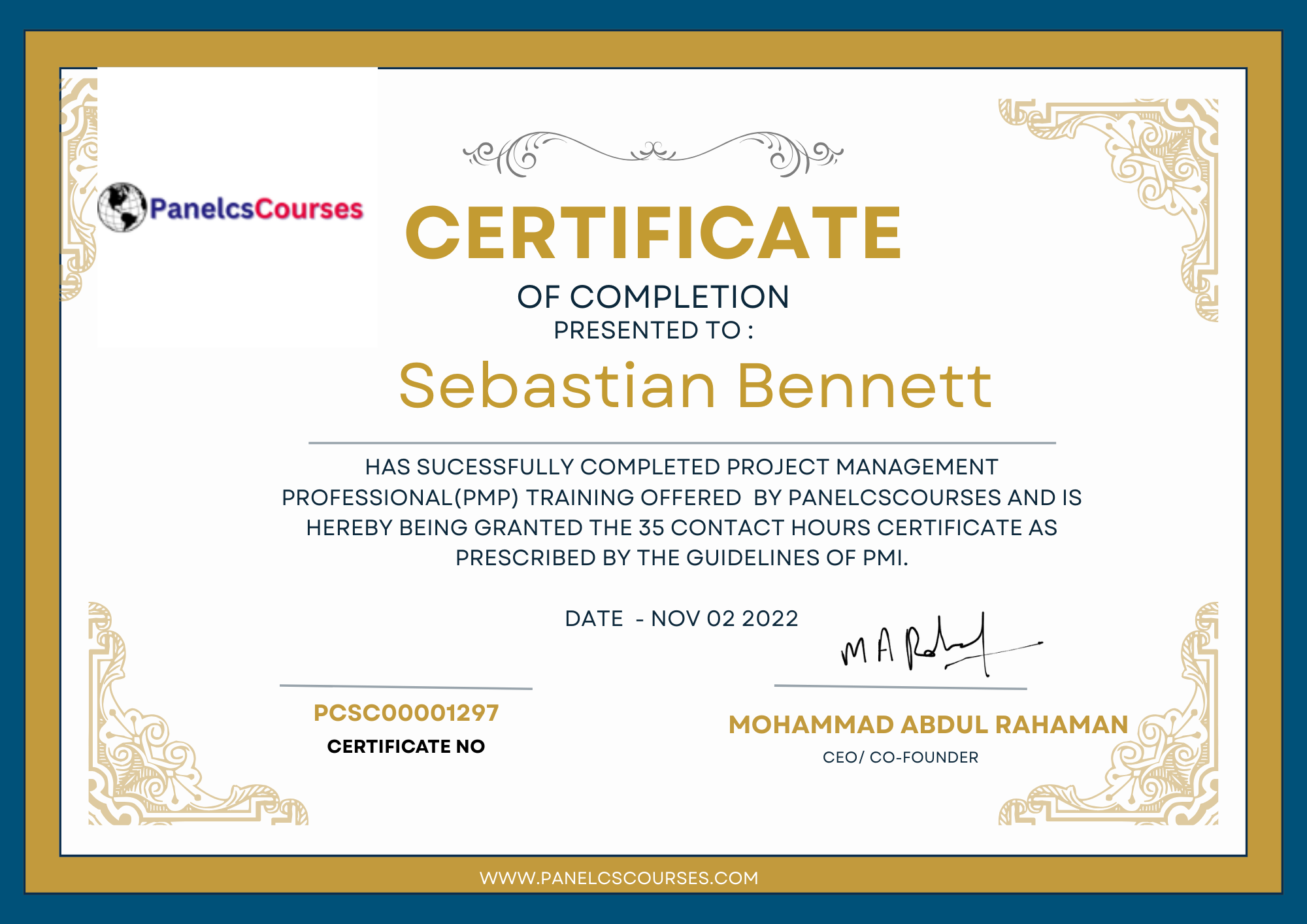
PMP Course Sample Certificate
Preetam Kumar

Preetam Kumar

Recommend Hussain Ali to everyone who is trying to get PMP certification, he is very comprehensive in explaining all the topics. If you are not clear on any topic, he gives multiple examples to make you understand. He guide you to answer questions PMP as well. He solve some of the critical questions during the session.

Nousheen Fatima

Nousheen Fatima

Trainer delivered excellent training. Apart from the scheduled course topics he covered many other topics from his 10+ years of Data Engineering experience which was very useful. He engaged the participants well, he listens to questions and provide relevant answers. did hands-on with participants and resolve their queries or issues on the fly. He also provide guidance on next areas of focus and books for future references.

Amit jha

Amit jha

It was a great learning experience. But there were a lot of new things that I learnt in this course. Main credit for the same goes to our trainer. She is an amazing trainer and knows exactly where to focus more, at what pace to proceed and where people might be struggling. Overall a very positive experience. Thank you expert trainer!

Preeti shetty

Preeti shetty

Garima is a great teacher with deep knowledge of AWS. The way Prashant explained the topic, performed the steps in front of class, answering the questions in between; generally creating end to end pipeline with different AWS components. Helping each student with the issues they were facing. So, for each topic we got to see him perform the work then we would replicate it and finally work on an assignment. This method proved very effective in understanding and learning the topic.

Rahul jain

Rahul jain

The instructor were knowledgeable and answered any questions the class had. They made sure we all were comfortable with the pace of the class and understood the material. It has been a great, pragmatic and knowledgeable experience. I think the interaction today was the best so far as we could talk to him. He is highly knowledgeable personality.

Mary

Mary

The faculty was fabulous. A wonderful experience, The trainer is very knowledgeable and clarifies the concepts. Thank you very much for excellent guidance.

Suresh Rao

Suresh Rao

Thoroughly enjoyed learning the PMP® Certification Training with an outstanding experienced instructor. The class was very interactive and he explained with a lot of examples. Looking forward to having many more sessions with him.

Roja

Roja

I am learning through Panelcscourses for over a year. I am having great learning time with panelcscourses. Especially trainer who taught us LSBBC was very knowledgeable. He is a dedicated teacher, who was selfless during his lectures. Looking forward for more learnings through panelcscourses. My rating is always 10/10.

Naga Rao

Naga Rao

I took Big Data Hadoop and Spark Developer at Panelcscourses. I would like to take this opportunity to thank the instructor. The course is well structured and explained the foundations with real-world problems with easy to understand the concepts.

Kranthi Vakati

Kranthi Vakati

My first experience with PanelcsCourses has been fabulous. A very professional platform with everything tailored to perfect, from the online enrollment to the materials online are at top notch. A special mention about the Trainer who is extremely knowledgeable and professional at work, the tons of experience clearly visible on the session Thanks everyone for all the help and Support.

Sajjan Kumar

Sajjan Kumar

It was great session of ITIL 4 with Amitava Sen session & Guidance, Professional attitude towards the learners , very excited content and flexible behaviors. It was a pleasure dealing with this platform.

Prem Rathode

Prem Rathode

Overall session was interesting and well explained with us. I will appreciate to join this training session. Good Luck!!

Vijay Kashyap

Vijay Kashyap

I attended the DevOps Practitioner course offered by Panelcscourses. This was one of the best sessions that I have attended. His has a very deep knowledge in DevOps and is stunning with all concepts. The session was very interactive and every doubts were cleared. The sessions were very well organized and did not encounter any technical glitches. At the end the faculty helped in completing the project as well.

Swamy Nathan

Swamy Nathan

Panelcscourses is the best Online Cloud Training Provider. Experienced Instructors having a lot of knowledge with each and every topic. They have great experience in production environment with top MNCs and they share their experience with us what kind of issues they do face in actual environment. Every topics they cleared by lots of diagram. They do their best but we also need to do ours. Great support by Panelcscourses.

Vikas Sharma

Vikas Sharma

It was a great learning experience with good content and also instructor justified the course by providing various examples and also made us practice with different cases. I would 100 % recommend others to take trainings from Panelcscourses. It is the best platform to make learners industry ready by providing them chance to explore real-life projects and 100% support assistance 24*7.

Rakesh

Rakesh

It was an great Learning Experience. It was an great Learning Experience. we have learned a lot for subject. instructor teaching was very informative and also keep the session interactive with slide quiz. Thank you for teaching us. I just have one complaint on responses on community thread. it would be great if it would responsive.

Varsha

Varsha

I want to appreciate Panelcscourses PMP Certification Training Program. Very knowledgeable, experienced trainer made the class interactive and enjoyable. Wish the course could accommodate more Q&A. Overall good. However need to elaborate the new terms/ words used in this training at the very beginning, so that we (who are totally new in this subject course) can understand the whole picture clearly.

OTHER TRAINING COURSES