


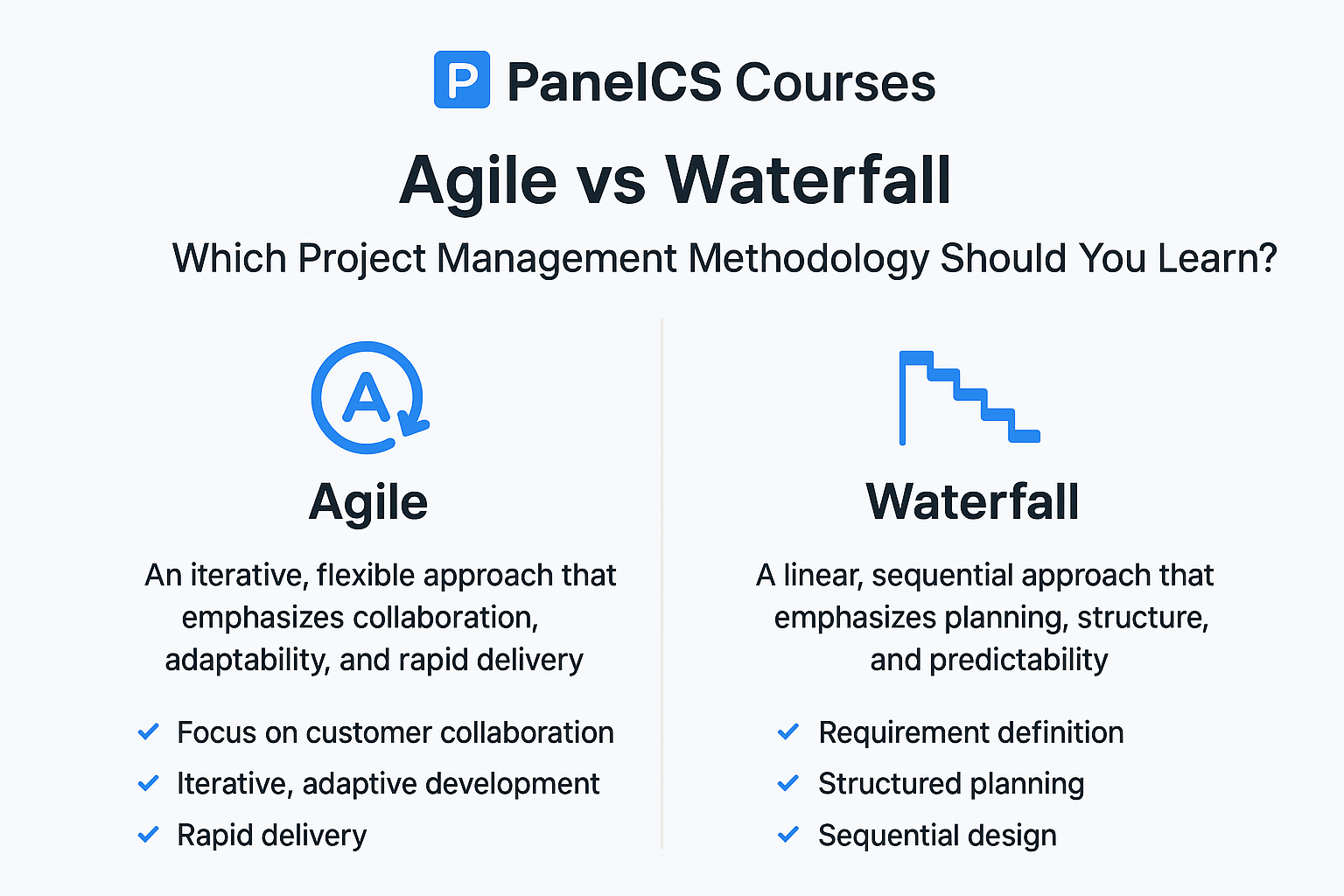
In today’s fast-changing business environment, project managers must choose the right methodology to ensure success. Two of the most widely used approaches are Agile and Waterfall. Both have strengths, both have weaknesses — but which one should you learn in 2025 to grow your career?
???? What is the Waterfall Methodology?
The Waterfall model is a traditional, linear approach to project management. Work is completed in sequential stages — once one phase ends, the next begins.
Key characteristics:
- Step-by-step process (requirements → design → development → testing → delivery).
- Clearly defined scope, budget, and deadlines.
- Best for projects where requirements are fixed and predictable.
Industries using Waterfall:
- Construction & engineering
- Manufacturing
- Government projects
- Large-scale infrastructure
Advantages:
? Simple and easy to follow
? Clear documentation and requirements
? Predictable timelines and costs
Disadvantages:
? Less flexible to changes
? Late testing may cause costly rework
? Not ideal for dynamic or evolving projects
???? What is the Agile Methodology?
Agile is an iterative, flexible approach that focuses on collaboration, adaptability, and continuous improvement. Work is divided into smaller cycles called “sprints” (usually 2–4 weeks).
Key characteristics:
- Focus on customer collaboration and feedback
- Incremental delivery of value
- Cross-functional, self-organizing teams
Industries using Agile:
- IT and software development
- Startups and product development
- Marketing and creative industries
- Finance and healthcare (increasing adoption)
Advantages:
? High adaptability to changes
? Faster delivery of usable product features
? Continuous customer feedback
? Encourages innovation and teamwork
Disadvantages:
? Requires strong team collaboration
? Less predictable costs and timelines
? Can be challenging for large, rigid organizations
???? Agile vs Waterfall: Quick Comparison
|
Feature |
Waterfall (Traditional) |
Agile (Modern) |
|
Approach |
Linear, sequential |
Iterative, flexible |
|
Scope |
Fixed at start |
Evolves with project |
|
Best for |
Predictable projects |
Dynamic, changing projects |
|
Delivery |
Final product at end |
Continuous, in sprints |
|
Change management |
Difficult |
Easy and adaptable |
|
Documentation |
Heavy |
Lightweight, flexible |
|
Industries |
Construction, government |
IT, startups, product teams |
???? Which One Should You Learn in 2025?
???? Learn Agile if:
- You want to work in IT, software, product management, or startups.
- You prefer dynamic, fast-paced environments.
- You’re aiming for certifications like CSM®, PMI-ACP®, SAFe Agilist.
???? Learn Waterfall if:
- You work in industries like construction, manufacturing, or government.
- Your projects have fixed scope, budgets, and strict compliance needs.
- You’re preparing for PMP® or PRINCE2® certifications, which include Waterfall principles.
???? Best Option:
For most professionals in 2025, learning Agile is a must — but a strong understanding of Waterfall gives you a complete toolkit. Employers value project managers who can adapt and use hybrid approaches (mixing Agile + Waterfall) depending on the project.
???? Final Thoughts
Both Agile and Waterfall methodologies are powerful in the right context. If you are aiming to grow in IT, digital transformation, or fast-moving industries, Agile should be your priority. But if you want to work in traditional sectors or aim for global certifications like PMP® or PRINCE2®, mastering Waterfall is equally important.
At PanelCS Courses, we train professionals in Agile, Scrum, PMP®, PRINCE2®, and Lean Six Sigma — helping you choose the right path based on your career goals.
???? Explore our Project Management Programs [Click Here] and take the next step toward becoming a certified professional.





Leave a Comment